
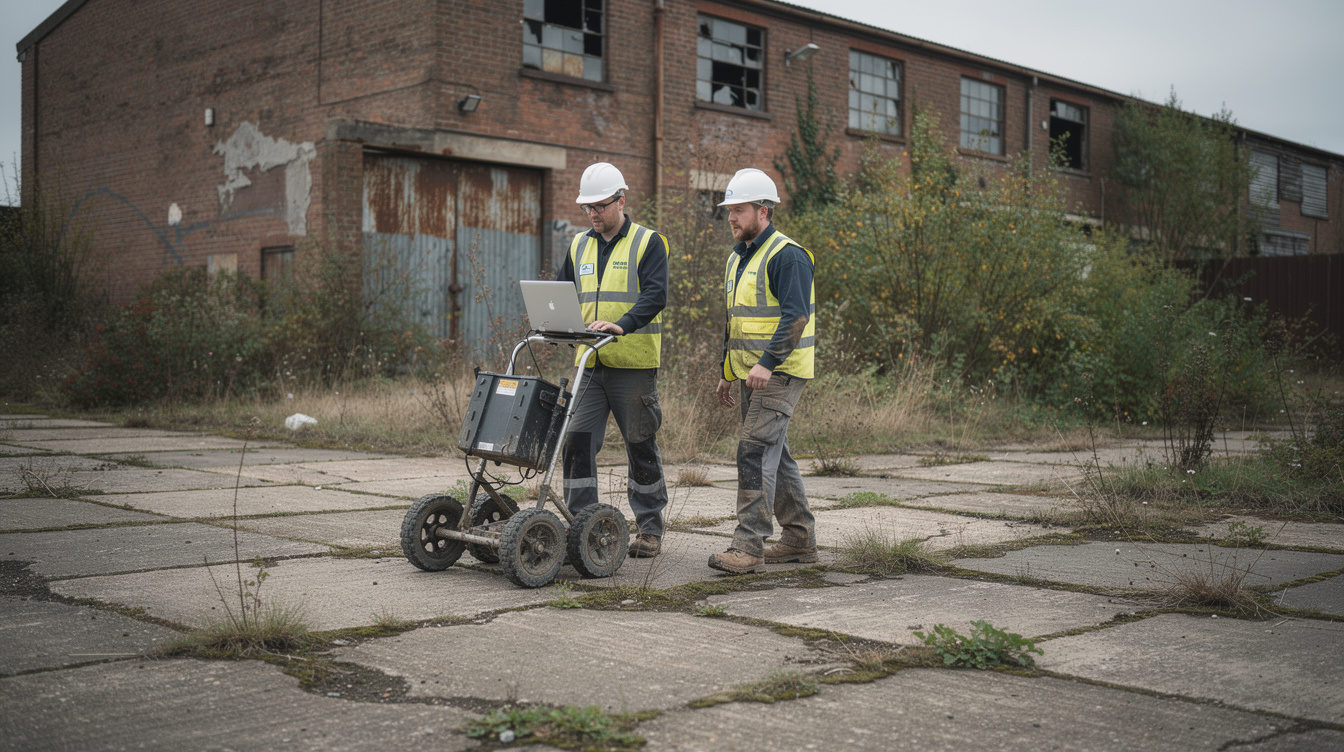
What is a Land Contamination Investigation?
A land contamination investigation is a systematic process used to identify, assess and quantify potential contamination in soil and groundwater. For property developers, homeowners and businesses across the UK, understanding whether your land is contaminated is not just a regulatory requirement – it can save you thousands of pounds and prevent serious health and environmental risks.
At Wesson Environmental, we carry out land contamination investigations across Bristol and throughout the UK. Our approach follows UK guidelines including CLR11 and BS10175 to ensure your investigation meets all regulatory requirements.
Why Do You Need a Land Contamination Investigation?
If you have a planning condition related to contaminated land, you will need a land contamination investigation. But even without a planning condition, there are several situations where an investigation is essential:
- Before purchasing land or property (to avoid inheriting contamination liabilities)
- When developing brownfield sites with previous industrial use
- For sites near former landfills, petrol stations or industrial facilities
- When building on agricultural land that may have been treated with pesticides
- If you notice unusual odours, staining or vegetation die-off on your site
Historical land uses across the UK have left a legacy of contamination. Even sites that appear clean on the surface may harbour contaminants from decades-old activities. For example, old orchards were often treated with lead and arsenic-based pesticides, whilst former gas works can leave behind coal tar and heavy metals.
The Land Contamination Investigation Process
A proper land contamination investigation follows a phased approach. Trying to skip stages will cost you more time and money in the long run, as regulators will reject incomplete reports.
Phase 1: Desktop Study
Every land contamination investigation begins with a Phase 1 Desktop Study. This desk-based research examines:
- Historical maps showing previous site uses
- Geological and hydrogeological data
- Environmental database records of pollution incidents
- Nearby sensitive receptors (water courses, aquifers, residential areas)
The desktop study produces a conceptual site model (CSM) which identifies potential pollutant linkages. A pollutant linkage requires three elements: a source (contamination), a pathway (how it travels) and a receptor (what it affects). If any element is missing, there is no risk.
In many cases, particularly for sites with low-risk historical uses, a desktop study alone is sufficient to discharge planning conditions. We never recommend further work unless it is genuinely necessary.
Phase 2: Intrusive Investigation
If the desktop study identifies potential risks, a Phase 2 intrusive investigation is required. This involves:
- Soil sampling using appropriate techniques (hand augers, window sampling or drilling)
- Installation of monitoring wells for groundwater assessment
- Laboratory analysis of soil and water samples
- On-site screening for volatile organic compounds
- Assessment of ground gas risks where relevant
The scope of the intrusive investigation must be based on the conceptual model from Phase 1. Random soil sampling without proper planning will not satisfy regulators and wastes your money.
Our contaminated land site investigations are designed to gather the right data efficiently, keeping costs down whilst ensuring regulatory compliance.
Phase 3: Risk Assessment and Remediation
Once laboratory results are available, we refine the conceptual model and carry out a detailed risk assessment. This compares contaminant concentrations against appropriate guideline values for your intended land use.
If risks are identified, remediation may be required. Remediation is not always about excavation and disposal – we assess all options including:
- Soil capping and cover systems
- Bioremediation
- Chemical treatment
- Stabilisation techniques
- Controlled removal and disposal
The most cost-effective solution depends on your site’s specific conditions and your development plans.
Common Contaminants Found in UK Soils
Different historical land uses leave different contamination signatures:
Former industrial sites: Heavy metals (lead, cadmium, chromium), petroleum hydrocarbons, asbestos, polycyclic aromatic hydrocarbons (PAHs)
Agricultural land: Pesticide residues (arsenic, lead), fertiliser compounds, fuel storage contamination
Former gas works: Coal tar, benzene, cyanides, phenols
Landfills and filled ground: Methane and carbon dioxide gases, leachate, heavy metals
Railway land: Creosote, heavy metals, asbestos
Each contaminant requires specific assessment criteria and may need different remediation approaches.
How Much Does a Land Contamination Investigation Cost?
This is one of the most common questions we receive. The honest answer is: it depends on what is actually required.
A Phase 1 Desktop Study typically costs between £800 and £2,000 depending on site size and complexity. Many sites require nothing further.
Phase 2 intrusive investigations vary widely based on:
- Site size and accessibility
- Number of sampling locations required
- Depth of investigation needed
- Types of laboratory analysis required
- Presence of groundwater or gas monitoring needs
We provide fixed-price quotes after reviewing your Phase 1 findings. We will always give you an honest appraisal of what is required – we never recommend unnecessary work.
Choosing the Right Contaminated Land Consultant
Not all land contamination investigations are created equal. Poor quality reports get rejected by regulators, costing you time and money to redo the work.
Look for consultants who:
- Have regulatory experience and good relationships with local authorities
- Follow current UK guidance (LCRM, BS10175, CLR11)
- Provide clear, fixed-price quotes
- Communicate directly with regulators on your behalf
- Never recommend work that isn’t necessary
At Wesson Environmental, our team has worked both in consultancy and in regulatory roles. This gives us insight into what regulators actually require, allowing us to have sensible discussions that benefit your project.
Next Steps
If you have a contaminated land planning condition or are concerned about potential contamination on your site, the first step is a Phase 1 Desktop Study. This will establish whether further investigation is needed and provide a clear roadmap for your project.
We offer free, no-obligation advice to help you understand your requirements. Our Bristol-based team works with clients across the South and throughout the UK, providing fast, cost-effective land contamination investigations that satisfy regulators first time.
Don’t let contaminated land issues delay your development. Contact Wesson Environmental today on 0117 369 0156 or email enquiries@wessonenvironmental.co.uk to discuss your project.
Recent Comments