
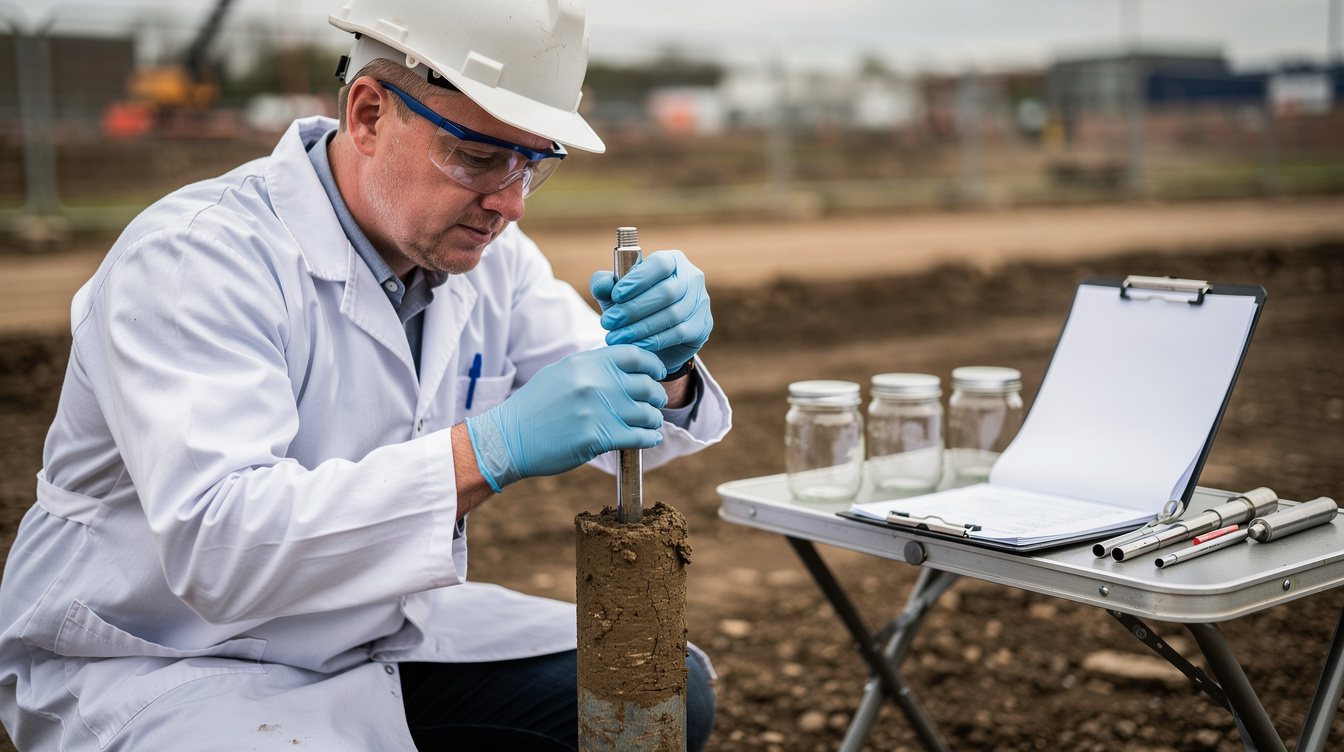
What is a Soil Contamination Survey?
A soil contamination survey refers to the whole site investigation process. This commences with the phase desktop study covered in a previous post. If a pollution linkage is identified, this is followed by a a Phase 2 site investigation or intrusive investigation, which is the actual physical testing of soils to determine whether contamination is present and whether it poses a risk to human health or the environment.
For property developers, homeowners, and businesses across Bristol and the UK, understanding when and why a soil contamination survey is needed can save significant time and money during the development process.
When Do You Need a Soil Contamination Survey?
A soil contamination survey is typically required when:
Planning Conditions Require It
Local planning authorities often impose conditions requiring contaminated land assessments. If your Phase 1 desktop study identifies potential contamination sources, the planning officer will require a soil contamination survey to quantify the risks before development can proceed.
Previous Site Uses Suggest Contamination
Former industrial sites, petrol stations, factories, dry cleaners, or even old orchards may have left contaminants in the soil. Lead, arsenic, petroleum hydrocarbons, and asbestos are common contaminants we encounter during soil testing services across the South of the UK.
Property Transactions
Buyers and lenders increasingly require soil contamination surveys before completing property purchases, particularly for commercial or industrial land. Understanding contamination liabilities protects all parties and can affect property valuations significantly.
Waste Classification is Needed
If you need to remove soil from your site, you must classify it correctly under UK waste regulations. Our waste classification services determine what the appropriate route for disposal is. This may form of the phase 2 investigation or it may be seperate activity.
What Does a Soil Contamination Survey Involve?
Site Investigation Design
Based on the findings of the Phase 1 desktop study, our contaminated land consultants design a targeted investigation. We determine:
- How many soil samples are needed
- Where samples should be taken
- How deep to sample
- Which contaminants to test for
- Whether groundwater monitoring is required
This targeted approach ensures you only pay for testing that is actually necessary, rather than expensive blanket sampling across the entire site.
Soil Sampling Methods
We use various techniques depending on site conditions and investigation objectives:
Hand sampling – Suitable for shallow investigations (up to 1.2 metres depth) on accessible sites. Cost-effective for residential developments where contamination risks are limited to surface soils.
Window sampling – A drilling technique that allows sampling to greater depths (typically 3-5 metres) without installing permanent boreholes. Ideal for assessing risks to groundwater and deeper contamination.
Trial pits – Excavated using a mechanical digger, trial pits allow visual inspection of soil layers and collection of bulk samples. Useful when waste materials or visual contamination need to be assessed.
Rotary drilling – Required for deep investigations or when drilling through rock. Often combined with installation of groundwater monitoring wells.
Laboratory Analysis
Soil samples are sent to UKAS-accredited laboratories for analysis. The testing suite depends on the potential contaminants identified in the Phase 1 assessment. Common analyis includes:
- Heavy metals (lead, arsenic, cadmium, nickel, etc.)
- Petroleum hydrocarbons (TPH, BTEX, PAH)
- Asbestos identification and quantification
- pH and soil chemistry
- Volatile organic compounds (VOCs)
We use on-site screening techniques where appropriate to reduce laboratory costs while still ensuring comprehensive assessment.
Understanding Your Soil Contamination Survey Results
Once laboratory results are received, our environmental consultants compare contaminant concentrations against relevant assessment criteria. In the UK, we typically use:
Generic Assessment Criteria (GAC)
Published by the Environment Agency and other bodies, these provide screening values for common contaminants based on different land uses (residential with gardens, residential without gardens, commercial/industrial).
Site-Specific Assessment
Where contaminants exceed generic criteria, we can carry out detailed quantitative risk assessment. This considers the specific characteristics of your site and proposed use to determine whether risks are actually present.
Conceptual Site Model
The contaminated land risk assessment is based on the source-pathway-receptor model. For contamination to pose a risk, there must be:
- A source (contaminated soil)
- A pathway (how people or the environment could be exposed)
- A receptor (people, buildings, groundwater, etc.)
If one of these elements is missing, there is no risk. For example, contaminated soil beneath hardstanding with no gardens poses minimal risk to residents because the pathway is broken.
What Happens if Contamination is Found?
If the soil contamination survey identifies unacceptable risks, several options are available:
Remediation
Our contaminated land remediation services can address contamination through various methods including excavation and disposal, soil treatment, or capping with clean material. The approach depends on the contaminants present and the proposed site use.
Planning Design Changes
Sometimes simple changes to site layout can eliminate risks. Installing hardstanding over contaminated areas, adjusting building locations, or modifying landscaping plans can be more cost-effective than soil removal.
Ongoing Monitoring
For some sites, particularly where groundwater contamination is present, long-term monitoring may be required to demonstrate that risks remain acceptable.
How Much Does a Soil Contamination Survey Cost?
Costs vary significantly depending on:
- Site size and complexity
- Number of samples required
- Depth of investigation
- Laboratory testing required
- Site access and ground conditions
A simple soil contamination survey for a single dwelling might cost between £1,500-£3,000, while larger commercial sites could require £10,000-£50,000+ of investigation. However, investing in a properly scoped investigation saves money in the long run by avoiding unnecessary testing or remediation.
At Wesson Environmental, we provide fixed-price quotes and never recommend work that is not necessary. We have extensive experience liaising with planning authorities across Bristol and the South of the UK to establish exactly what is required, ensuring you get value for money.
Choosing a Contaminated Land Consultant
Your soil contamination survey must be carried out by suitably qualified and experienced contaminated land consultants. Look for:
- Relevant qulifications, meberships or experience
- Experience with your type of site and development
- Good relationships with regulators
- Clear, understandable reporting
- Transparent pricing with no hidden costs
We have completed hundreds of soil contamination surveys across Bristol, Bath, Swindon, Exeter, and throughout the UK. Our reports are designed to meet regulatory requirements while providing practical, cost-effective solutions for your development.
Getting Started with Your Soil Contamination Survey
If you need a soil contamination survey for a planning condition, property transaction, or development project, contact our team for a free consultation. We can review your Phase 1 desktop study, discuss your requirements, and provide a fixed-price quote within 24 hours.
Call us on 0117 369 0156 or email enquiries@wessonenvironmental.co.uk to discuss your soil testing services requirements. Our Bristol-based team is here to make contaminated land assessment as straightforward and cost-effective as possible.
Recent Comments